- Intellego Newsletter
- Posts
- The Future of Work

The End

From time to time, I catch myself humming the mission impossible theme song. Perhaps I’ve watched the movies several times, and the melody stuck to my mind. Or life sometimes seems to be like in the movie.
I confess this article was almost a mission impossible. I could blame the creativity blockage on the Easter break and Mercury retrograde, but it was pure laziness. Let’s be honest, that’s what Easter is all about - rest.
Remember, the most valuable hours are the ones dedicated and spent with family, friends and whatever makes us happy. That’s your most important mission in life. Don’t let people and things jeopardize your plans.

We’re being ambushed. Abort mission, that’s an order.
Among many topics discussed on the long weekend meetings, one stand out: work. So let’s dive into it.
I start this edition with one question. Are you ready for the end of your career? The rise of sophisticated technology is causing jobs to vanish. It’s not a secret to anyone.
Did you notice more self-service checkouts machines than cashier attendants at the supermarket? What about the factory floor employees or elevator operators? Have you seen any?
Here is the undeniable truth. Those who did or do only the mechanical work will lose their jobs to robots. Jobs in different industries and countries are vulnerable to automation. Nowadays, there is a new trend. Artificial intelligence (AI) is being introduced to mental operational functions.
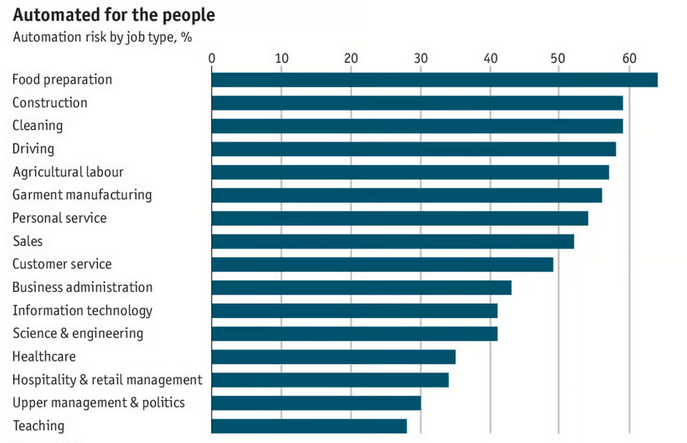
Source: OECD
The job market is changing. I see in my bubble that people are resigning, switching jobs faster than before. Teams, leaders, and companies are experiencing unprecedented impacts from high turnover rates.
It’s not just younger generations, but company directors, senior managers and experienced employees. People cannot take it anymore. The tsunami of information and stimuli floods all aspects of our lives.
No one can stand working anymore. At least not following the traditional models. But what is happening? We are in the middle of a technological revolution. The world has changed more in the last decade than it has in the previous century.
The pandemic was a catalyst event - driving a permanent shift in how we work. Our educational and organizational systems are falling behind as I explored in edition 003.
The industrial-era model no longer works. Processes, systems, entire industries are being disrupted and redesigned. Speed, speed, speed, no time to lose. People don’t want to spend time. In fact, they want ready solutions for their daily problems.
Imagine spending two plus hours of your day on commuting to work. No way, right? I’ve been there. I used to commute 4 hours every day for almost 2 years. That lifestyle taught me the power of consistency and long-term view.
I don’t miss those days, but we all need to start somewhere and pay the bills on time. Ironically, we spend hours scrolling shorts on social media, but we don’t complain whatsoever. Don’t even call me a weak generation for stating that. But that’s the reality.
“When we are no longer able to change a situation, we are challenged to change ourselves.”
The Truth

We’re raised to have badges, own a bank account and be risk averse. This is the typical archetype of someone born in the 80s, 90s or early 2000s. Most of us heard our parents saying: “You have to study and become independent.” That was the success formula sold to us.
Suddenly, we signed employment contracts, assuming that life is all sorted out like in a screenplay. For many, it would be the end of problems. For others, just the beginning of some. Don’t delude yourself. There’s no ready answer.
Why do we keep seeking stability in a complex and uncertain world? Is the current work model sustainable to you? And why younger generations don’t want to be leaders?
According to Harvard career consultant Gorick Ng, only 2% of young people (born between 1997 and 2012) have the goal of climbing the corporate hierarchy where they work, meaning taking on leadership positions.
People want freedom, flexibility, autonomy. Employees want to get work done when, how, and where they’re most productive. It does not matter if it is at the office, at home, at a coffee shop, at the beach or at a hotel lobby. Geographical location is no longer an issue.
Each generation has their own personal views on how and where they want to work. Of course, there are challenges to overcome, pros and cons. Managing teams remotely is a challenging task. After all, managers want results; not excuses.
The world is changing faster than we could ever imagine. Which do you favor: being on the sidelines or in the midst of the technological chaos? It is time to become irreplaceable. At least try it, you will not regret the attempt.
“Modern jobs lack creativity. The best way to fill the void is with a side hustle.”
The Strategy

Cultivate a beta mindset
Anyone who is not rare will lose their space in the job market. What should you do to avoid being replaced? Regardless of the machine having its algorithms and apparently thinking by itself, our competitive edge is the human factor.
It’s clear that there are technologies that arrive and quickly change reality. If you adopt a behavior of complacency or conquered ground, new solutions will go viral. Eventually, you will incorporate them into your lives. Remember, everyone was skeptical about the first cellphone.
Don’t fall behind, invest in yourself. Cultivate a growth mindset, expand your knowledge, explore horizontal career opportunities and build a career portfolio. The strategy here is to broaden your skill set, grow expertise in different fields by taking new challenges.
A machine only solves a problem when there is a human programming, transforming and improving processes in the background. Our role as humans is to cultivate a beta mindset focused on continuous development.
Where is the human factor? Human beings need to remember that their role in generating value is changing. The fixed mindset focused on execution and operational activities is outdated.
The future belongs to the creative minds. People who can leverage your problem-solving skills based on a unique set of experiences. Find the sweet spot between your genuine interests, field of expertise and your personality.
To proceed to the next phase of the game, you will need to evolve your character and collect new resources and skills like in the video games as mentioned in edition 001.
Position yourself as a valuable asset in the digital age by sharing knowledge, practical advice, and unique perspectives that help people solve problems and create positive change. Here are six strategies to consider:
Embrace continuous learning: stay ahead, commit to lifelong learning.
Cultivate a growth mindset: adapt to new technologies, learn and grow from failures.
Develop unique skills: identify emerging trends and technologies and master them.
Foster creativity: creative minds become more valuable as automation rises.
Build networks: enroll in events and engage in online networking platforms.
Adapt to change: be agile, be open-minded, learn new tools and technologies.
Why is it important? Why should you care about this new trend in the market? Because your future depends on it.
Because you just started your career and one day you want to stop working. Or you’re an experienced employee seeking new opportunities, or you feel lost in the middle of this technological hurricane.
Regardless, where you stand, focus on the infinite game of self-mastery. Keep in mind, knowledge is something no one can take from you.
“Conquer yourself rather than the world.”
Talk to you next week.
Light and peace,
—FMV
🧠 My Mental Download:
📕 (1) What I'm reading:
🎧 (2) What I'm listening to:
🤓 (3) What I'm studying:
🤿 Keep diving and exploring:
💡 Intellego is the process of gaining insights to better understand the world.
✍️ Letter is written by Fabíola Maia-Veres every Tuesday at 7pm.
🐝 Newsletter is configured and sent by BeeHiiv.